

Validate each user's source IP
Bind partner accounts and groups to their expected source networks, adding identity-aware access control beyond a network firewall.

- Updated
- 2026-08-20
A network firewall can restrict which addresses may reach a file transfer service. It cannot confirm that the account used on an allowed connection belongs to the organization operating that source network.
SFTPPlus MFT closes this gap by validating the source IP address against the authenticated user or the user's groups. The connection must come from a network allowed for that identity, not just from any network allowed by the firewall.
Prevent one partner from impersonating another
Consider a service used by Partner A and Partner B. Partner A connects from 192.0.2.0/24, while Partner B connects from 198.51.100.0/24. The network firewall allows both ranges so that both partners can reach the service and transfer files.
If someone at Partner A obtains Partner B's credentials, the firewall still permits the connection because it originates from an approved Partner A address. Without an additional identity-aware check, those credentials could be used to authenticate as Partner B.
With SFTPPlus, Partner A's account is restricted to 192.0.2.0/24 and Partner B's account is restricted to 198.51.100.0/24. An attempt to use Partner B's credentials from Partner A's network is rejected, even though the firewall allows that network to reach the service.
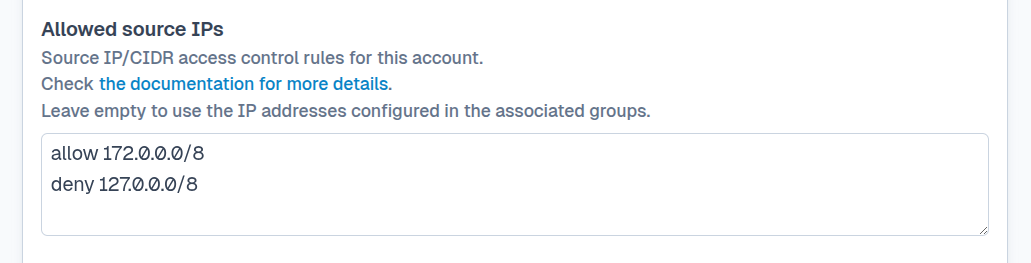
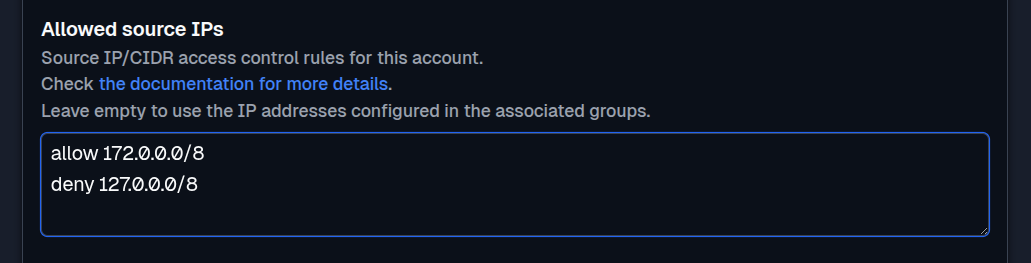
Manage source networks by user or group
An individual account can have its own list of accepted and rejected IPv4 or IPv6 addresses and CIDR ranges. This is useful when a partner has a dedicated account or requires an exception from a shared policy.
For organizations with several users, the source IP rules can be defined on an SFTPPlus group. Accounts associated with that group use the shared network rules, which avoids copying the same configuration to every user. Group-based rules also work with users authenticated through external identity systems, allowing network access to follow the SFTPPlus group assigned during authentication.
Add identity-aware control to existing network protection
Per-user source IP validation complements rather than replaces the firewall. The firewall limits which networks can open a connection, the SFTPPlus security policy filters and automatically blocks sources, and the account or group rule verifies that the source is valid for the requested identity.
This layered approach reduces the impact of stolen partner credentials and prevents an approved network from becoming a path into another partner's account. Authentication attempts and their source addresses are recorded in the SFTPPlus audit logs for investigation and monitoring.
See the source IP filtering options for accounts and groups for configuration details.