

IP filtering and automatic blocking
Protect file transfer services with explicit source IP rules and automatic temporary blocks for repeated failed authentication attempts.
'%20/%3e%3crect%20width='900'%20height='300'%20fill='url(%23grid)'%20/%3e%3ccircle%20cx='170'%20cy='150'%20r='122'%20fill='%231c7894'%20opacity='0.09'%20/%3e%3ccircle%20cx='746'%20cy='149'%20r='126'%20fill='%2357d0d4'%20opacity='0.08'%20/%3e%3cg%20fill='none'%20stroke-linecap='round'%3e%3cpath%20d='M96%2078%20C210%2078%20282%20104%20368%20126'%20stroke='%2378def0'%20stroke-width='5'%20/%3e%3cpath%20d='M96%20150%20H358'%20stroke='%23ffbf69'%20stroke-width='5'%20stroke-dasharray='13%2012'%20/%3e%3cpath%20d='M96%20222%20C210%20222%20282%20196%20368%20174'%20stroke='%2378def0'%20stroke-width='5'%20/%3e%3cpath%20d='M518%20150%20H674'%20stroke='%237de2c2'%20stroke-width='7'%20/%3e%3c/g%3e%3cg%20filter='url(%23shadow)'%3e%3ccircle%20cx='92'%20cy='78'%20r='23'%20fill='%23e9f9ff'%20/%3e%3ccircle%20cx='92'%20cy='78'%20r='10'%20fill='%2320a9c9'%20/%3e%3ccircle%20cx='92'%20cy='150'%20r='23'%20fill='%23ffe3bb'%20/%3e%3ccircle%20cx='92'%20cy='150'%20r='10'%20fill='%23f68b3c'%20/%3e%3ccircle%20cx='92'%20cy='222'%20r='23'%20fill='%23e9f9ff'%20/%3e%3ccircle%20cx='92'%20cy='222'%20r='10'%20fill='%2320a9c9'%20/%3e%3c/g%3e%3cg%20transform='translate(252%20121)'%20filter='url(%23shadow)'%3e%3ccircle%20cx='29'%20cy='29'%20r='29'%20fill='%23c83e51'%20/%3e%3cpath%20d='M17%2017%2041%2041M41%2017%2017%2041'%20fill='none'%20stroke='%23fff'%20stroke-width='7'%20stroke-linecap='round'%20/%3e%3c/g%3e%3cg%20transform='translate(356%2038)'%20filter='url(%23shadow)'%3e%3cpath%20d='M94%208c38%2028%2074%2030%2074%2030v66c0%2065-43%20104-74%20118-31-14-74-53-74-118V38s36-2%2074-30Z'%20fill='url(%23shield)'%20stroke='%23c9fbff'%20stroke-width='5'%20stroke-linejoin='round'%20/%3e%3cpath%20d='M52%2079h84M52%20108h84M52%20137h84'%20stroke='%23073354'%20stroke-width='13'%20stroke-linecap='round'%20/%3e%3c/g%3e%3cg%20transform='translate(676%2073)'%20filter='url(%23shadow)'%3e%3crect%20width='122'%20height='154'%20rx='17'%20fill='url(%23server)'%20stroke='%23eaf9ff'%20stroke-width='4'%20/%3e%3crect%20x='17'%20y='20'%20width='88'%20height='31'%20rx='8'%20fill='%23174a6b'%20/%3e%3crect%20x='17'%20y='62'%20width='88'%20height='31'%20rx='8'%20fill='%23174a6b'%20/%3e%3crect%20x='17'%20y='104'%20width='88'%20height='31'%20rx='8'%20fill='%23174a6b'%20/%3e%3ccircle%20cx='88'%20cy='35.5'%20r='5.5'%20fill='%2373e2c0'%20/%3e%3ccircle%20cx='88'%20cy='77.5'%20r='5.5'%20fill='%2373e2c0'%20/%3e%3ccircle%20cx='88'%20cy='119.5'%20r='5.5'%20fill='%2373e2c0'%20/%3e%3cpath%20d='M31%2035.5h34M31%2077.5h34M31%20119.5h34'%20stroke='%238acade'%20stroke-width='5'%20stroke-linecap='round'%20/%3e%3c/g%3e%3cg%20transform='translate(600%2041)'%20opacity='0.9'%3e%3ccircle%20cx='28'%20cy='28'%20r='24'%20fill='%230a2a49'%20stroke='%2382e8e3'%20stroke-width='4'%20/%3e%3cpath%20d='M28%2014v14l10%207'%20fill='none'%20stroke='%23fff'%20stroke-width='5'%20stroke-linecap='round'%20stroke-linejoin='round'%20/%3e%3c/g%3e%3c/svg%3e)
- Updated
- 2026-08-12
Public file transfer services regularly receive automated login attempts. Attackers can repeatedly try passwords, probe common usernames, and consume resources in the authentication systems behind the service.
SFTPPlus MFT includes source IP protection in the file transfer service itself. The same security policy can filter connections and respond to repeated authentication failures across SFTP, FTPS, and HTTPS services.
Stop brute force authentication attempts
A brute force attack sends repeated login attempts until it finds valid credentials. Even unsuccessful attempts can increase log volume and place unnecessary load on Active Directory, LDAP, external identity providers, or custom authentication APIs.
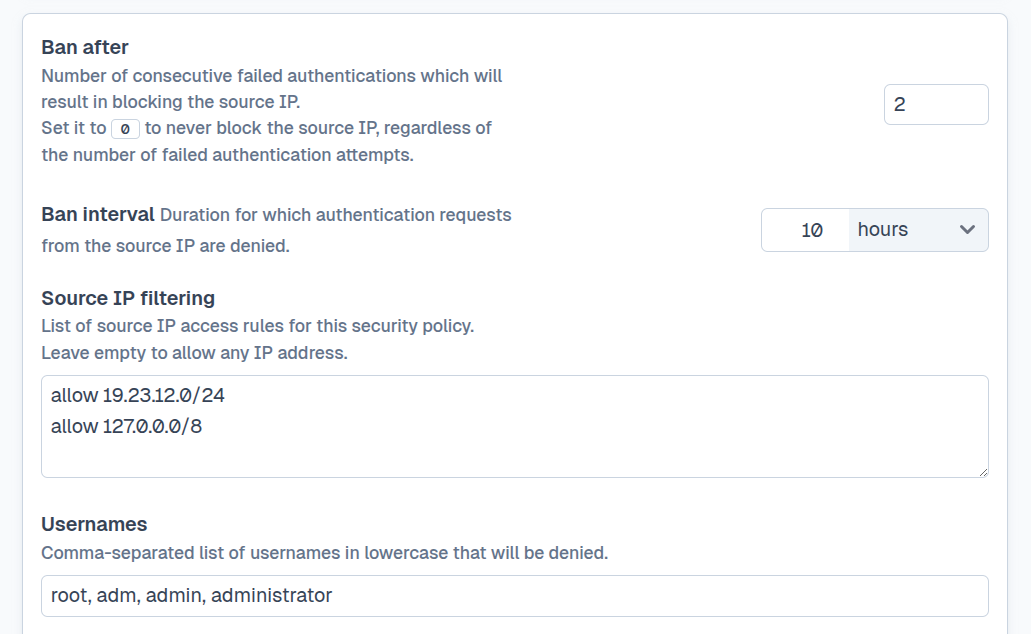
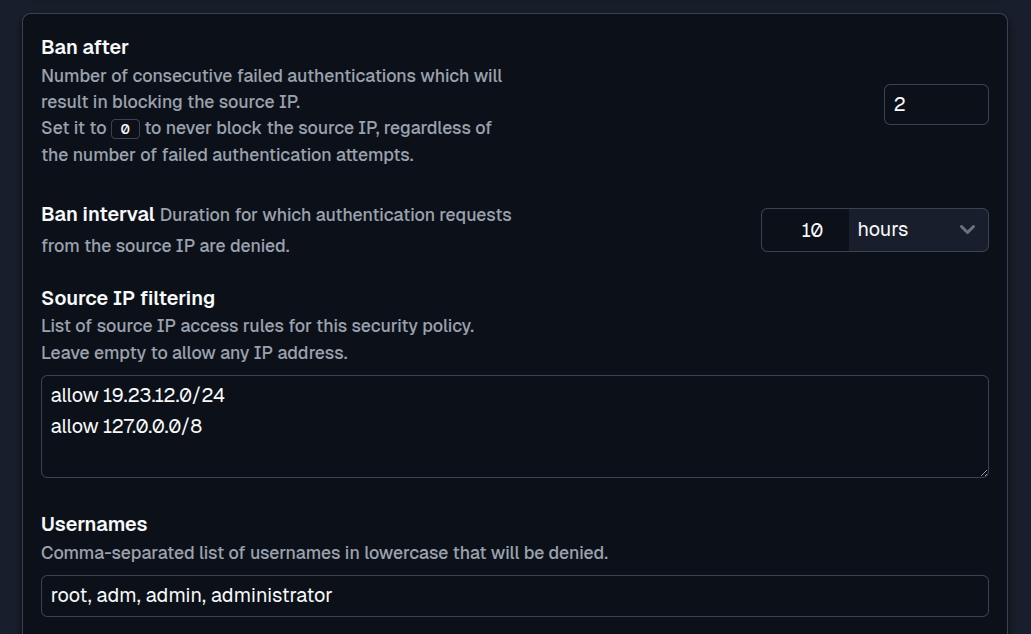
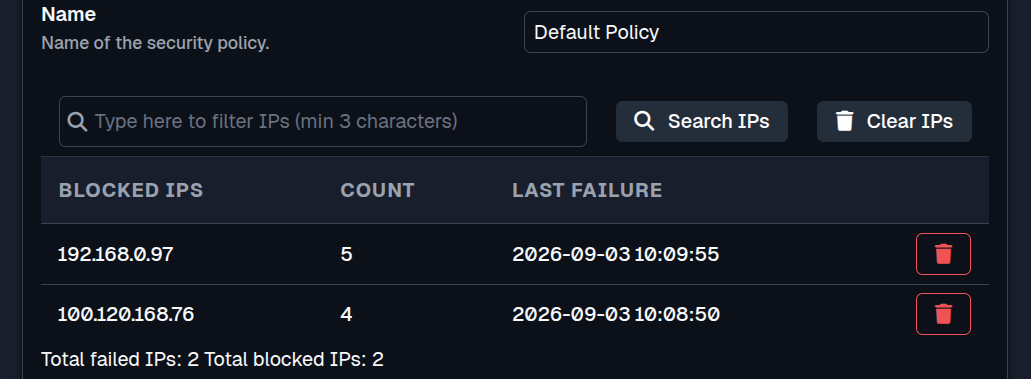
An SFTPPlus security policy can count consecutive failed authentications from a source IP address. After the configured limit is reached, further authentication requests from that address are blocked for a defined interval. This temporary block slows automated attacks before they continue through the authentication process.
Apply firewall-style rules inside SFTPPlus
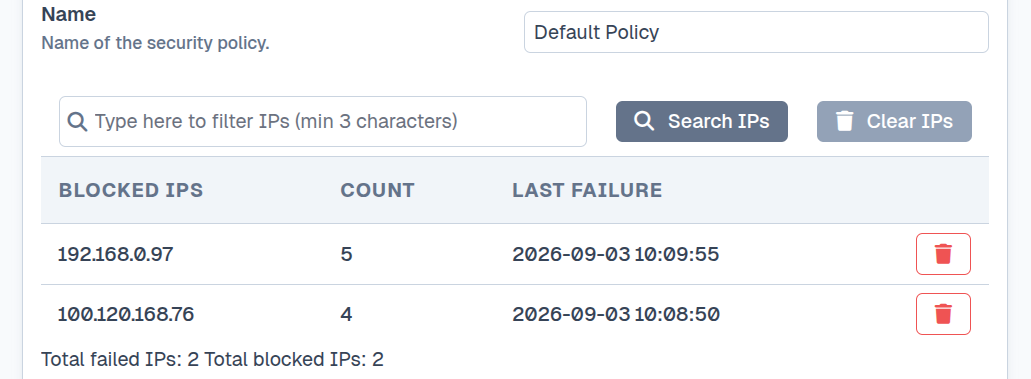
Source IP rules provide an application-level firewall for file transfer services. Administrators can reject a specific IPv4 or IPv6 address, reject a network expressed in CIDR notation, or explicitly accept trusted addresses and networks.
These rules are useful when a known hostile network should be blocked before authentication, or when a service should only accept connections from known corporate and partner networks. Different file transfer services can use different security policies, so an internet-facing partner service does not need to share the same rules as an internal service.
Handle trusted sources without losing protection
Some trusted systems, such as internal automation or a partner gateway, should never be affected by an automatic block. SFTPPlus can explicitly accept these addresses and exempt them from the remaining security policy checks, including brute force protection.
Other known addresses can still be permitted to connect without being exempted. When an address is not explicitly accepted or rejected by the source IP rules, the remaining security checks continue. This distinction lets administrators decide which sources are fully trusted and which should remain subject to automatic protection.
Use explicit network rules instead of geoblocking
SFTPPlus MFT does not use a connection's reported country as an access rule. IP geolocation can produce false positives when partners use cloud infrastructure, corporate VPNs, mobile networks, or address ranges whose registration does not reflect their actual location.
Instead, administrators can define the exact IP addresses and network ranges that should be accepted or rejected. This approach bases access on partner and corporate network information that can be verified directly.
For configuration options and the precise rule evaluation behavior, see the SFTPPlus security policy documentation.
When SFTPPlus runs behind a proxy or load balancer, configure the network path to preserve the original client address. The security policy must receive that address for source IP filtering and automatic blocking to work as intended.